Large-format printing (LFP) is characterized by a wide variety of substrates. This raises the question of how to verify that your print colours are sufficiently predictable. After all, this is a requirement before you can begin ink reduction. For example, grey component replacement can only work well if your black tonal scale is under control! We investigated this on the Arizona printer at Canon in Diegem.
Downloads
Forex
Forex is a foamed PVC sheet material with a high dose of optical brighteners (fluorescence) and low gloss (matte). When printing on the Canon Arizona printer, matte ink (IJC358) was used.
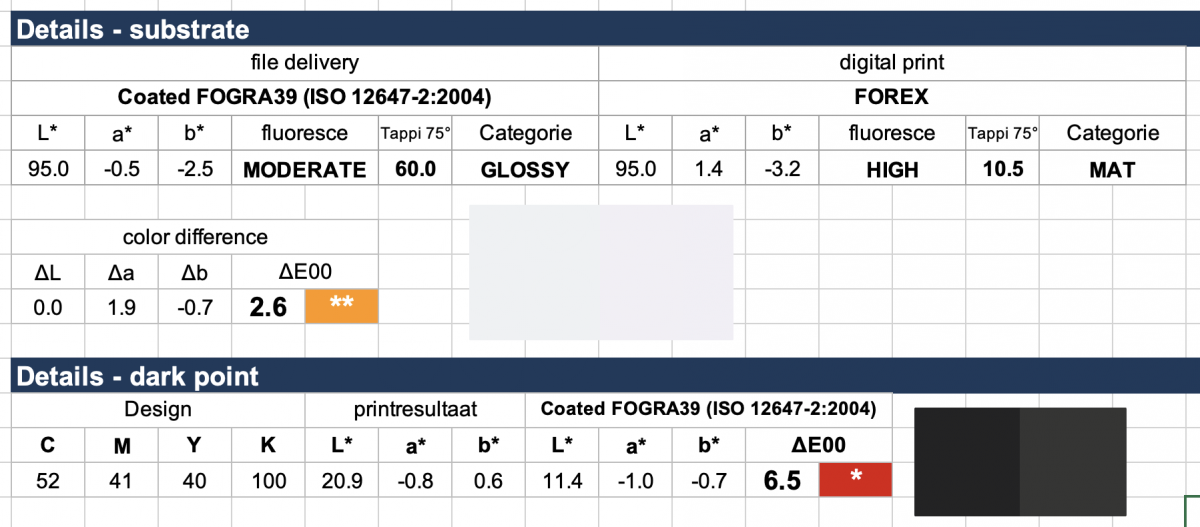
Fig. 1. The dynamic range of print work on Forex compared with coated offset.
The matte materials (forex and matte ink) make it challenging to fully reproduce the ‘Coated FOGRA39’ colour space: three cross-sections for dark (L=30), mid-tone (L=50), and pastel colours (L=80) clearly demonstrate this.

Fig. 2. Colour reproduction on Forex compared with offset on coated paper: the red circle is the reference (maximum colour in offset), the white circle the Forex print result. Colour differences are calculated using the dE00 formula.
Consistent Print Colours
Consistent Print Colours
Before you can apply ink reduction for LFP printing on Forex, you need to verify that your printer colour profile is up to date. A double assessment clarifies the situation:
- Print colour versus offset colour, “colorimetric”: this assessment is a measure of “Quality,” or how well the Forex colour space fits within the ‘Coated FOGRA39’ space.
- Print colour versus offset colour with adjustment to the smaller dynamic range of printing on Forex, “colorimetric with Black Point Compensation”: this is a good measure of the calibration state of the printer.
If you conduct the same evaluation for an extended set of offset colours (1200 test patches), you can derive a dE00 95% value from all colour differences: this parameter represents the colour consistency of the print. The dE00 95% score is the colour difference below which 95% of all tested colours were printed.

Fig. 3. Example of the double assessment for “Quality” and “Color management.”
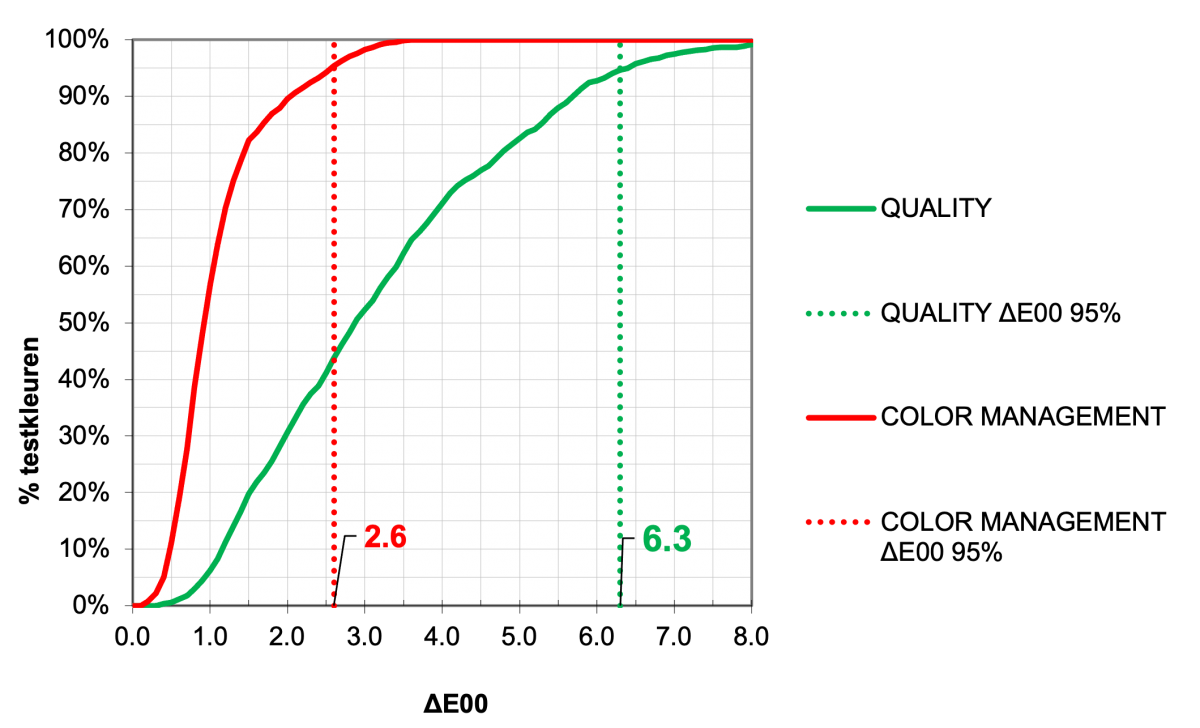
Fig. 4. The dE00 95% parameter applied to “media-relative” (quality) and “media-relative with black point compensation” (color management). The low score for “media-relative” shows that printing on matte FOREX differs substantially from offset on glossy coated paper. The high score in color management indicates that the forex print process is nevertheless well calibrated.
Next Step: Ink Reduction
In this calibrated print process, options can now be explored to minimize ink consumption. Previous newsletters explained the technique of using maximum ink limits and grey component replacement. The ink consumption of the following situations can be compared:
- Print with CMYK + light cyan and light magenta, without ink limits
- Print with CMYK inks using a colour profile, without ink limits
- Print with CMYK inks using a colour profile with maximum ink reduction
Consumption
CMYK + lm lc, no ink limit – 18 ml
CMYK, no ink limit – 10 ml
CMYK, maximum ink reduction – 5 ml
Table: Ink consumption of the 3 configurations. For CMYK printing, 50% ink is saved, and without light magenta/light cyan even 72%!
If we analyse the impact on print colours, we can classify our 1200 test colours into categories based on colour differences. Using the tolerances of contract proofing (ISO 12647-7), we still end up with several combinations in the red zone, but overall this can be considered a sellable print.

Fig. 5. Overview of colour differences after applying ink reduction. Colours with deviations above dE00>5 (in red) fall outside contract proofing tolerances (ISO 12647-7).

Fig. 6. A visualization of the largest colour differences in the dark areas.
Conclusion
The LFP sector is characterized by a wide variety of print substrates. Even on matte and lower-quality substrates, ink reduction is possible. By performing the double comparison, you gain insight into the limitations and the calibration status of the printer. For less critical applications, a kind of “ECO mode” with minimal ink consumption is feasible: a satisfied customer with significantly lower production costs.
